



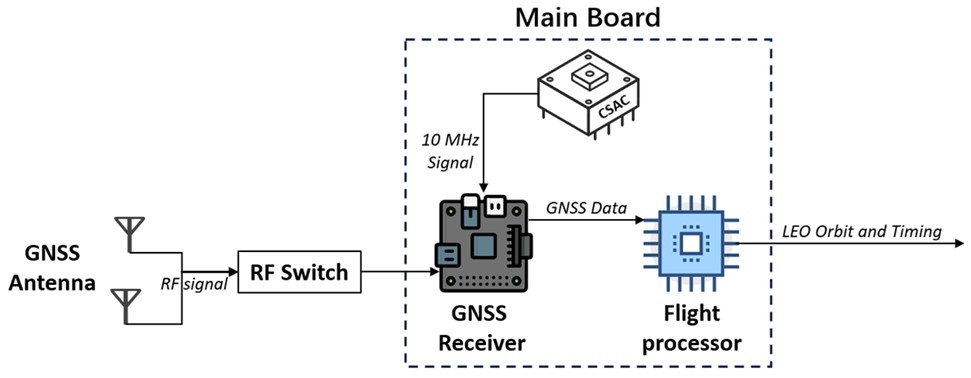
Low Earth Orbit (LEO) satellites have emerged as a strategic global trend in aerospace development, attracting significant attention across defense, national security, and commercial sectors. China's next-generation Beidou Navigation Satellite System is now focusing on LEO constellation development. Meanwhile, driven by the Hong Kong Government's 2025 Policy Address promoting aerospace science and technology advancement, Hong Kong has streamlined procedures for LEO satellite license applications, positioning itself as a key player in this industry. Currently, LEO satellites face substantial challenges in real-time precise orbit determination and timing. Traditional methods rely on ground-based post-processing, requiring hours or even days to determine accurate orbital positions and timing information. This significant delay severely restricts applications in remote sensing, disaster management, weather forecasting, and other time-critical scenarios. Existing onboard positioning systems, such as Single Point Positioning (SPP), can only achieve meter-level accuracy because they depend on less precise GNSS broadcast ephemerides and clock products.
The innovation of this project lies in integrating Precise Point Positioning (PPP) technology into spaceborne systems. It will develop real-time precise orbit determination and timing software paired with an efficient, low-cost hardware platform, achieving real-time sub-decimeter-level accuracy in orbit and timing calculations. The system will process multi-frequency and multi-constellation GNSS observations collected onboard, with ambiguity resolution to further enhance positioning accuracy. Additionally, the project will refine dynamic force models to better account for non-conservative forces such as solar radiation pressure and atmospheric drag. The project's deliverables will significantly enhance LEO satellites' positioning, navigation, and timing capabilities, expanding their real-time application scenarios. This advancement will drive breakthroughs in Hong Kong's satellite technology and promote industry growth in smart cities, intelligent transportation, and environmental monitoring, strengthening Hong Kong's strategic position in the Greater Bay Area aerospace ecosystem.
Prof. Wu Chen, Head (LSGI) & Chair Professor of Satellite Navigation, Department of Land Surveying and Geo-Informatics, The Hong Kong Polytechnic University